

Development ·
Microservices vs. monolithic: our take on modern development with NestJS
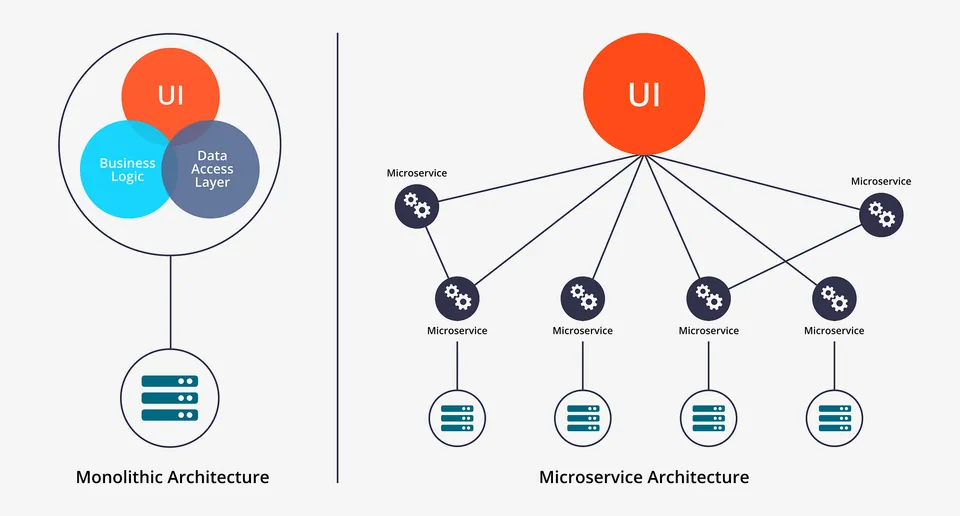
At Script Solutions we’ve built projects of every size and complexity, across many languages, and watched architectural patterns evolve first-hand. Here are our insights on a decision every development team faces — microservices or a monolith — with a focus on our experience with NestJS.
Monolithic architecture: the classic approach
For many projects a monolith is a solid foundation: a single, unified application whose components are tightly coupled.
- Simplicity. In smaller projects, monoliths are straightforward to develop and deploy. NestJS’s modular structure makes robust monoliths a breeze.
- Rapid development. For quick iterations and proofs of concept, a monolith gets you moving fastest.
- Challenges. As projects scaled we hit limits: deployments became cumbersome, updates risked the entire application and scaling individual features was difficult.
Microservices: the scalable future
Microservices split an application into small, independent services, each responsible for one business capability.
- Scalability and flexibility. NestJS’s built-in microservices support, including message brokers such as RabbitMQ and Kafka, lets us build resilient systems and scale services independently.
- Technology diversity. Each service can use the best stack for its job — a data-intensive service might need a different database than authentication.
- Fault isolation. A failure in one service doesn’t take down the whole application.
- Development agility. Small, independent teams ship faster.
- Increased complexity. Inter-service communication, distributed tracing and deployment get harder — NestJS’s structure and documentation help a great deal.
Choosing the right architecture
- Project size and complexity: small to medium projects with well-defined scope are often well served by a monolith; large, evolving projects benefit from microservices.
- Scalability requirements: if you must handle heavy traffic or scale features independently, choose microservices.
- Team size and structure: microservices suit larger teams that need to work independently.
- Long-term vision: consider how your application will grow and evolve.
NestJS: a powerful tool for both
Whichever you choose, NestJS’s modular structure, TypeScript support and rich ecosystem make it an excellent foundation for monoliths and microservices alike.
We’ve shipped both architectures with NestJS, and understanding the trade-offs is what makes software succeed. Talk to us about choosing the right pattern for your project.